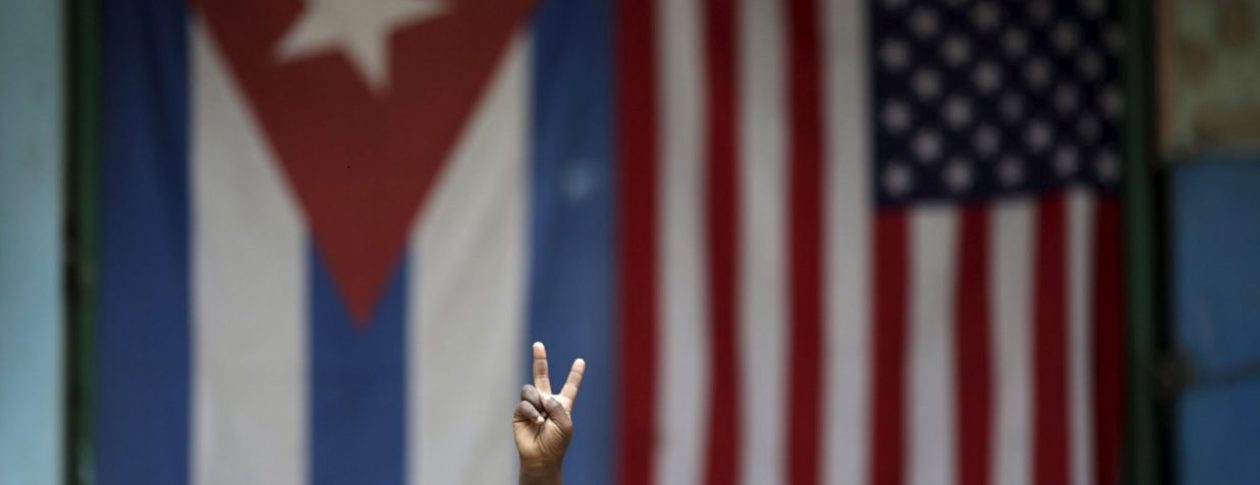
Category Archives: Cuba and US Relations

Cuban officials have recently held talks with representatives of the U.S. government

Photo: Estudios Revolución

In accordance with the consistent policy that the Cuban Revolution has defended throughout its history, led by Army General Raúl Castro Ruz as leader of the Revolution, and by the First Secretary of the Central Committee of the Communist Party and President of the Republic, Miguel Díaz-Canel Bermúdez—and in collegial action with the highest structures of the Party, the State, and the Government—Cuban officials have recently held talks with representatives of the United States government.

President Díaz-Canel Bermúdez announced this from the headquarters of the Central Committee of the Communist Party of Cuba, before members of the Political Bureau, the Secretariat of the Central Committee of the Communist Party, and the Executive Committee of the Council of Ministers.

The president stated that “these talks have been aimed at finding solutions, through dialogue, to the bilateral differences between our two nations. International factors,” he said, “have facilitated these exchanges.”

“The purpose of these talks,” the Head of State added, “is, first and foremost, to identify the bilateral problems that require solutions.”

As part of this purpose, the president explained, is also “to determine the willingness of both sides to take concrete actions for the benefit of the people of both countries. And in addition, to identify areas of cooperation to confront threats and guarantee the security and peace of both nations.”

Also included among the objectives, the First Secretary of the Central Committee of the Communist Party of Cuba reasoned, is working for the security and peace of the Latin American and Caribbean region.

In his remarks, Díaz-Canel emphasized: “It is important to remember that it has not been, nor is it now, the practice of the leadership of the Cuban Revolution to respond to speculative campaigns on this type of issue. This is a matter that is unfolding as part of a very sensitive process, which is being conducted with seriousness and responsibility, because it affects bilateral relations between the two nations and demands enormous and arduous efforts to find a solution and create spaces for understanding, allowing us to move forward and away from confrontation.”

The Head of State then said that “in the exchanges that have taken place, the Cuban side has expressed its willingness to carry out this process on the basis of equality and respect for the political systems of both states, for sovereignty, and for the self-determination of our governments.”

“And this has been proposed taking into account a sense of reciprocity and adherence to International Law,” the dignitary asserted during a meeting also attended by the President of the National Assembly of People’s Power and the Council of State, Esteban Lazo Hernández; the Prime Minister, Manuel Marrero Cruz; the Secretary of Organization of the Central Committee of the Communist Party of Cuba, Roberto Morales Ojeda; and the Vice President of the Republic, Salvador Valdés Mesa—all members of the Political Bureau.

Later in his remarks, the Head of State reflected that whenever we have experienced tense moments, such as this confrontation with the United States government, individuals and institutions have emerged that have facilitated the establishment of channels for dialogue.

The president affirmed that, “in these moments of extreme tension, these possibilities have also arisen” for creating spaces for understanding.

CUBA IS ONE, STATEMENT BY THE MINISTRY OF FOREIGN AFFAIRS OF CUBA

Photo: Cubaminrex

On May 28, the U.S. Government finally announced a set of measures to put into effect its May 16, 2022 announcements. The objective of this step, according to the text published by the Office of Foreign Assets Control (OFAC), is to favor the private sector in Cuba.
The measures are limited and do not touch the fundamental body of the blockade against Cuba nor the additional sanctions that make up the policy of maximum pressure. Once again, the US government’s decision is based on its own distorted vision of the Cuban reality, by artificially separating the private sector from the public sector, when both are part of the Cuban business system and of society as a whole.
With this announcement, the U.S. Government intends to target only one segment of our population. It does not eliminate or modify the coercive measures that today most affect the Cuban economy and public services and that severely damage the well-being of our entire population.
If the announced measures are implemented, the United States seeks to put the private sector, which has been legally established and has grown under the measures taken in a sovereign act by the Cuban Government in consultation with the Cuban people, at an advantage. The same has happened with Internet access established and expanded by Cuba despite the obstacles of the blockade and restrictions to prevent free access to hundreds of tools and websites.
The U.S. government has been explicit in its intention to use this sector for political purposes against the Revolution, depending on its regime change objectives.
Even if this is a capricious selectivity, both the public and private sectors will continue to suffer the consequences of the blockade and the absurd inclusion of Cuba in the list of States that allegedly sponsor terrorism.
The coercive measures that make up the economic blockade will remain in force with cruel effect on the entire Cuban population. It is evident that the U.S. ratifies its will to punish Cuba’s state sector, knowing that it provides essential services such as education, health, culture, sports and others to all Cubans, including the private sector; and that it is the guarantee of social justice and equity among citizens. For this reason, recent measures were taken by the U.S. Government to persecute Cuba’s international medical cooperation and documents have been published that reveal that it is continuing its efforts to deprive us of income and destabilize the country for political purposes of domination.
The Cuban Government will study these measures and, if they do not violate national legislation and mean an opening that benefits the Cuban population, even if only a segment, it will not hinder their implementation.
Havana, May 28, 2024

What Became of Joe Biden’s 2020 Election Promises?

What Became of Joe Biden’s 2020 Election Promises?

By Raúl Capote Fernández on December 15, 2023

photo: efe

The current US president, Joe Biden, will complete his term of office in January 2025, by which date the four years provided for in Article 2 of the Constitution of the United States will be completed.

He has been as warmongering as his predecessors, the most aggressive hawks linked to the war industry have found in his administration space for their imperial delusions, thus placing the world on the brink of a global conflict, generating crises of incalculable consequences.

“I will return our combat soldiers in Afghanistan home during my first term”, he announced, thus concluding the longest war in US history, with a chaotic end, however, he is the architect of lethal conflicts in other parts of the world, such as the conflict in Ukraine, he escalated serious situations of tension with China and Iran and is an accomplice of the Zionist massacre in Gaza, Palestine.

During his inauguration on January 21, 2021, Biden said: “I am going to put all my soul into this, into bringing America back together”, referring to the deep divisions in society, aggravated during the mandate of his predecessor, the Republican Donald Trump.

Today, however, those divisions are even greater and the country is fragmented and polarized.

Immigration, guns and minorities, three emblematic issues, are considered part of Biden’s biggest failures, as mass shootings have increased, he has not passed a law to protect African Americans’ access to vote, nor has he curbed racists police abuses against them.

His campaign promise to grant legal status to the nearly 11 million undocumented people residing in the country remains in limbo.

The hope of an immigration reform to open the path to citizenship for millions of migrants and especially for the “dreamers”, the young people who came to the United States as children, also remains on the back burner.

Allowing Medicare to negotiate the price of drugs and eliminating the death penalty were some of his commitments to reach the White House.

However, he has been unable to push through Congress an assault weapons ban and his ambitious plan to forgive some student debt was rejected outright by the Supreme Court.

“Make public colleges and universities free for all families whose income is less than $125,000 a year,” he said, but Washington has also failed to make this promise a reality.

Biden has maintained the position that building a border wall is ineffective. But the White House recently authorized the completion of some sections of the wall, for budget reasons, thus extending the dreams of Trump.

As president, he enacted a law authorizing the federal government to negotiate lower prices for some drugs for Medicare beneficiaries, but without repealing existing law, adding an exception, i.e., nothing from Bidencare as he said during a debate in October 2020.

Since taking office, he has taken no action to make this Bidencare proposal a reality, which could mean for Americans, the ability to enroll in a government-run health plan.

Meanwhile Cubans are still waiting for Biden’s campaign promise of improving relations with the island when the reality is that the ongoing affects of the blockade and the renewal of Cuba on the unilateral list of States sponsoring terrorism has only made things worse.

Donald Trump, in spite of his affirmative speeches, did not fulfill the commitments announced during the campaign either. He proclaimed himself many times as the most effective president in history, but in truth, he did very little except go backwards.

Raúl Capote Fernández is a Cuban professor, researcher and journalist. He is a frequent contributor to Resumen Latinoamericano.


President Raúl Castro Ruz, received a delegation from the United States Congress

Raúl receives U.S. Congressional delegation
Affairs of interest to both countries were discussed during the meeting
Author: Granma | internet@granma.cu
february 21, 2018 08:02:13

Raul-y-congresistas-580


Photo: Estudio Revolución

Army General Raúl Castro Ruz, President of Cuba’s Councils of State and Ministers, yesterday afternoon received a delegation from the United States Congress, led by Senator Patrick Leahy (D-Vermont).
The group also included two other Democratic Senators, Ron Wyden from Oregon and Gary Peters from Michigan, and House Representatives James McGovern (D-Massachusetts) and Susan Davis (D-California).
Affairs of interest to both countries were discussed during the meeting.
Additionally present on the Cuban side were Foreign Minister Bruno Rodríguez Parrilla and Carlos Fernández de Cossío, the ministry’s general director for the United States.