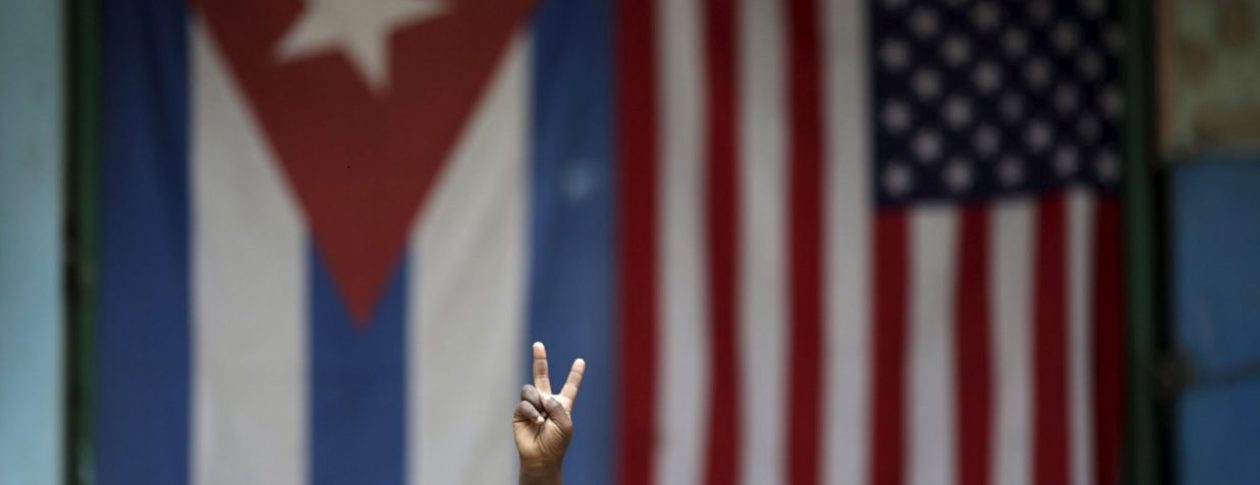
Cuba condemns and denounces new escalation of U.S. economic blockade
Statement by the Revolutionary Government
Photo: Ricardo López Hevia
The Revolutionary Government condemns in the strongest terms the new escalation by the U.S. government against Cuba in its efforts to impose a total blockade on fuel supplies to our country.
The executive order issued by the U.S. President on January 29, 2026, declares a supposed national emergency, under which his government will be able to impose trade tariffs on imports of products from countries that supply oil to Cuba.
To justify such extreme action, the text of the order contains an extensive list of lies and defamatory accusations against Cuba. Among them is the absurd assertion that Cuba constitutes an “unusual and extraordinary threat” to the national security of the United States. The President himself and his government are aware that no one, or very few, can believe such mendacious arguments, but they do not care. Such is their contempt for the truth, public opinion, and government ethics when it comes to endorsing their aggression against Cuba.
With this decision, the United States government, through blackmail, threats, and direct coercion of third countries, is attempting to impose additional pressure on the economic suffocation measures that have been in place since Trump’s first term to prevent fuel from entering our country. It consolidates a dangerous way of conducting U.S. foreign policy by force and exercising its ambitions to guarantee its imperialist hegemony. As announced, that country claims the right to dictate to sovereign states which nations they can trade with and to which they can export their domestic products.
The executive order issued by the President of the United States therefore constitutes a flagrant violation of international law and also contravenes the Proclamation of Latin America and the Caribbean as a Zone of Peace. It confirms that it is the government of that country that is threatening the security, stability, and peace of the region and the world.
The government of the United States has reached this point after 67 years of failing to surrender and destroy a genuine and legitimate political and revolutionary process of full sovereignty, social justice, and the promotion of peace and solidarity with the rest of the world.
Cuba’s historical willingness to engage in serious, responsible dialogue with the United States government, based on international law, sovereign equality, mutual respect, reciprocal benefit, non-interference in internal affairs, and absolute respect for the independence and sovereignty of states, is widely documented.
As everyone knows, including the U.S. government itself, Cuba poses no threat whatsoever to the United States, its national interests, or the well-being of its citizens, who, moreover, have always been treated with respect and hospitality when their government has allowed them to visit the island. Cuba does not threaten or attack any country. It is not subject to sanctions by the international community. It is a peaceful, supportive, and cooperative country, willing to help and contribute to other States.
It is also a country of a brave and combative people. Imperialism is mistaken when it believes that economic pressure and the determination to cause suffering to millions of people will break their determination to defend national sovereignty and prevent Cuba from falling, once again, under US domination.
The international community faces the inescapable challenge of determining whether a crime of this nature could be a sign of things to come or whether sanity, solidarity, and the rejection of aggression, impunity, and abuse will prevail.
We will face this new attack with firmness, equanimity, and the certainty that reason is absolutely on our side. The decision is one:
Even with fuel shortages, Cuba will not be defeated by the empire
“Surrender will never be an option, and hard times like these must be faced with courage and bravery,” said the Cuban president.
Our premise will continue to be to prepare ourselves to move forward even when aggression and restrictions become more acute, Díaz-Canel said. PhotoPhoto: Estudios Revolución
“We are living in a time when imperialism is emboldened and has once again set its sights on Cuba with increased aggression, which grows with each passing day,” denounced Miguel Díaz-Canel Bermúdez, First Secretary of the Central Committee of the Communist Party of Cuba and President of the Republic, on Friday morning during the Extraordinary Plenary Session of the Provincial Party Committee in Havana.
The Head of State made an incisive analysis of the events that have unfolded in the region and the world since January 3, following the aggression against Venezuela by the U.S. government, and which now threaten the island.
Faced with imperialism’s aggression against Cuba, whose direct lines of action have been clearly announced by Trump, Marco Rubio, and other spokespeople for that government, “we,” Díaz-Canel said, “have to be prepared, and we are preparing ourselves.”
The president explained that these lines of action consist, first, of total suffocation, continuing economic pressure, as reflected in the decisions announced Thursday by Trump on the blockade through tariffs on oil supplies to Cuba, and second, military aggression.
He recalled the comments made by the White House occupant in early January, after the aggression against Venezuela and the kidnapping of its legitimate president, when he said that not much more pressure could be exerted on Cuba and that what had to be done was to go in and destroy the place.
The first of these comments, when he said “I don’t think much more pressure can be exerted” against Cuba, Díaz-Canel pointed out, is confirmation of the extreme levels of pressure of all kinds that have been exerted on our country, although, indirectly, Trump has had to acknowledge that we have resisted.
They “have applied all the pressure they can, and here we are. And that statement, made with such arrogance, debunks the lie that Cuba is a failed state, because they have had to acknowledge that the fundamental cause of the economic crisis the country is experiencing has to do with that pressure, which they themselves describe as maximum.”
With this statement, the First Secretary added — Trump has also had to acknowledge that there is nothing left to deprive and block the Cuban people of, and now, with the executive order to impose tariff sanctions on those who supply us with oil, they want to deprive us of fuel, something necessary for any country to develop its economy, to develop its life, and “we must see,” he denounced, “with what malice, with what perversity, they are proposing this policy.”
Regarding the second part of Trump’s comments earlier this month, when he said that with Cuba, the only option left is to “go in and destroy the place,” Díaz-Canel pointed out that this is “a phrase that provokes outrage and popular revulsion because it implies the ruthless massacre of our country.”
The head of state condemned “the unveiling of the annexationist swarm” that is euphorically celebrating Trump’s executive order to block our access to oil on social media.
Imperialism, he emphasized later, “is concerned about the example of Cuba, what Cuba can do without the blockade, what another type of model, another type of construction, another type of popular empowerment can mean for the world, which, even under blockade, has had social results in 65 years that the United States does not have.”
Díaz-Canel analyzed the elements that are facilitating or imposing the behavior of the current U.S. administration.
He spoke about the updating of the Monroe Doctrine with the Trump corollary and the criterion of imposing peace through the use of force, although, he noted, we must see what that peace is, because wherever force has been applied, in all the conflicts in which the United States is involved, there is no peace; what there is is chaos. By using force, he stressed, the US is crushing the concept of multilateralism that is defended by most of the world.
Díaz-Canel asserted that “when an empire is in decline, it is totally irrational,” and what can be expected from it is “a reaction of arrogance, bullying, blackmail, pressure, coercive measures, violence, slander, and lies.”
EMPIRE OF EVIL
The President returned to his assessment of the Empire’s military invasion of Venezuela and the kidnapping of President Nicolás Maduro Moros and his wife Cilia Flores.
This aggression, he recalled, was preceded by an intense campaign of economic, political, and propaganda pressure that intensified beginning in September 2025 and the largest U.S. military deployment in the Caribbean area in more than 20 years.
The way in which the aggression against Venezuela was structured, the Caribbean leader commented, also contains elements of the war we are facing, because this, he emphasized, is also an ideological war, a cultural war, and a media and communications war.
“Ideological, because what is being imposed here is the hegemony of an empire and its desire to conquer and dominate the world. And it is a hegemony that responds to the great imperialist powers and responds to the rich minorities of the world.
“It is a cultural war because, in order to conquer the world hegemonic ally, it is necessary to break each people’s relationship with their culture and their historical roots so that people see their values and history as obsolete and then accept the patterns that imperialist hegemony wants to impose.”
In the media sphere, the dignitary exposed the multiple communication matrices that were generated from the Empire’s propaganda platforms, including social media, to shape public opinion that would justify what they were going to do next, which intensified starting last September.
Then, following the thread of events, came the pressure, the naval blockade, the illegal bombing of ships allegedly involved in drug trafficking, the blockade on hydrocarbons and the hijacking of oil tankers, and finally, the invasion and kidnapping of the legitimate president of a country and his wife to try them illegally in another country.
And these, Díaz-Canel denounced, “are the same pretexts that are already being constructed against us to justify an aggression against Cuba, to justify coercive measures, to continue increasing pressure against Cuba.”
We are facing an imperial doctrine that also has its sights set on Greenland and Iran; in other words, he said, we are facing a stark imperialist and fascist aggression in which the president of the Empire is behaving like Hitler, with a criminal policy of contempt that aims to take over the world.
SURRENDER WILL NEVER BE AN OPTION
Delving deeper into the threats looming over Cuba, Díaz-Canel pointed out: “Now they are deluded into thinking that the days of the Revolution are numbered, that we are going to collapse under our own weight, that they are going to suffocate us, and that is, once again, an expression of imperial arrogance.”
It is an illusion that contrasted with the reaction of the Cuban people to the aggression against Venezuela on January 3. A people, he recalled, that “reacted with indignation, with patriotism, against imperialism and with unity.”
During the aggression, he recalled, “the Cubans fought and fought hard, confronting elite U.S. forces that had rehearsed an operation to kidnap the president in a matter of minutes, with superior manpower, superior technology, superior weaponry, drones, a sophisticated deployment of technology, and tremendous firepower.”
One day, Díaz-Canel emphasized, we will have to recognize how much the courage and example of the 32 Cubans who fell fighting the US invasion of Venezuela contributed to everything that is happening and everything that may happen in the future. And the Empire, he said, has to calculate “what an attack on Cuba would cost it.”
That is why, he said, our premise will continue to be to prepare ourselves to move forward even when aggression and restrictions become more acute. “Surrender will never be an option,” the Cuban president assured, “and hard times like these must be faced with courage and bravery.”
“Our Party, the State, the Government, the Revolutionary Armed Forces, the Ministry of the Interior, and the united people are prepared to face any additional blockade measures and any military threat or aggression with the same courage and determination as the 32 Cuban combatants who fell heroically on January 3 in Venezuela,” he emphasized.
In view of the growing aggressiveness of the United States, the First Secretary said that an international complaint will be made in all possible forums about this new coercive measure and that work will continue with friendly countries and the international community.
“We,” said the president, “are a country of peace. Even in the midst of all this aggression and the blockade of all these years, we have said that we have the capacity and willingness to dialogue with the U.S. government. The thing is, dialogue cannot take place under pressure. Dialogue must be on equal terms, with respect, and without preconditions.”
When today at least a moment is dedicated to commemorate and dignify the victims of genocide, to “think” about how to prevent it, it seems better to invoke all those resistances that confront it
Photo:Illustrative
There are those who want to dedicate one day of the year to what takes lifelong struggles. There are those who want to wash their conscience with symbolic and isolated acts that generate commemorative postcards, easy to post on WhatsApp stories.
The word genocide is not enough to describe certain things, certain historical and tremendous traumas, from which most of us come from.
Genocide, according to the academy of language, is the systematic extermination or elimination of a human group because of race, ethnicity, religion, politics or nationality. But it has always had a little more behind it than it says, because race and ethnicity invented it, religion and politics manipulate it and nationality prostitute it.
We already know who they are, we know the smell of how they look and the dull spectrum their planes make when they launch themselves to break the sound barrier and a few other barriers.
We already know how they talk, that there are words that they repeat a lot and others that they never mention, that they love to throw around blame and responsibility, that they change the subject quickly, that they can do it, they have what they need.
Genocide… What do they think we mean by people being killed? A common crime that is erased with three days of crying, four months of pain and a hundred wakes?
We already know that it is not only our bodies that hinder them: they also have more than enough of the full, distinct and rich freedom of our sensibilities, the willingness to pledge our words and our lives in function of our words and our lives, the other ways of saying how a people is organized or where and for what or for whom wealth is placed, the “I don’t feel like it” similar to the priceless tantrum….
This December 9th, a day in which a large part of the world dedicates at least a moment to commemorate and dignify the victims of genocide, to “think” about how to prevent it, it seems better to us to invoke all those resistances that confront it.
The daily ones that even they themselves do not know they exist, the past ones, the high-flown ones, those who know how to cry, those who prefer to save their tears for later, the silent ones, the future ones, those who assume, as the poet said, “that all the words with which I sing to life come with death as well.”
“The day when future generations ask why we did not stop the holocaust, we will not have a dignified and reasonable answer,” said Cuban President Miguel Díaz-Canel Bermúdez in X
Photo: Prensa Latina
U.S. Secretary of State Antony Blinken recently visited Tel Aviv and publicly stated that “perhaps” this is “the last chance for a ceasefire in Gaza”.
A few kilometers away from the meeting with the authorities of the Jewish country, a Dantesque spectacle, very similar to that left by the U.S. atomic bombs dropped on the cities of Hiroshima and Nagasaki, is the testimony of the Palestinian identity subjected to extermination in the Gaza Strip.
Logic indicates that a solution to this conflict is a long way off as long as a foreign actor – the U.S. – finances and supports Benjamin Netanyahu’s Zionist regime within the framework of the UN and other international institutions.
It must be made clear to Joe Biden and Blinken – once again sent to Israel as a kind of “fire-fighter” in the face of international condemnation – that they hold the solution in their hands: force Israel to stop the genocide in Palestine, or the White House will suspend the delivery of the most advanced weapons and the financial support of more than U.S. $4 billion a year.
In addition, the Biden administration, or the next one, can lift the veto in the UN Security Council when it comes to peace in Palestine and the cessation of Israeli aggression.
Coinciding with Blinken’s visit to Israel, the UN, in the voice of its Secretary-General António Guterres, called for “an end to impunity for attacks on humanitarian workers,” 280 of whom from 33 countries were killed last year alone.
And lest we forget, the number of Palestinians killed by Zionist shrapnel exceeds 40,000, not counting the estimated 10,000 more buried under the rubble of what was once Gaza City.
It is not the time for the visits of the Yankee representative or his worthless warnings, nor for the resolutions and appeals of the international institutions, which are neither heard nor followed by those guilty of genocide.
There is no direct action to stop the crime.