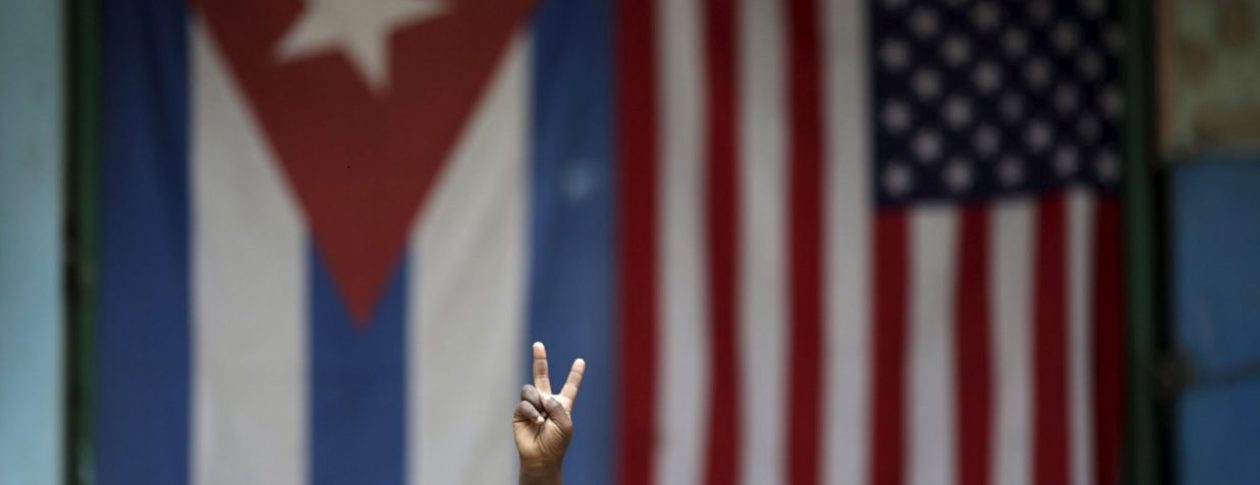

From the White House on January 29, President Donald Trump declared a national emergency regarding Cuba, which he declared an “unusual and extraordinary threat to the national security and foreign policy of the United States,” the same country that has been blockaded for more than six decades.
Although they want to make it look like a security measure, it really is the use of pressure as a geopolitical and destabilization tool. Among its aims, it seeks to collectively punish the Cuban people for their firm decision to choose the path of sovereignty and the right to self-determination, which they will not renounce.
Thus, the Executive Order signed by the U.S. president comes into force today, declaring a national emergency in that country, given that – according to the document full of fallacies – Cuba possesses “sophisticated military and intelligence capabilities on its territory that directly threaten the national security of the United States” and maintains relations with “hostile countries, transnational terrorist groups, and malign adversaries” of the northern nation.
The U.S. government is lying again, as it does systematically. It knows full well that Cuba does not harbor terrorists, does not give refuge to terrorist organizations, does not torture alleged opponents, and does not cooperate illegally with any country. It is in that territory that murderers such as Luis Posada Carriles, responsible for the Barbados plane crime, and others who still walk the streets of Miami have found shelter.
With the “imperative duty to protect” the United States, the Republican president announced that he will impose new tariffs “on imports of goods from a foreign country that sells or supplies, directly or indirectly, oil to Cuba.” This will hit a cross-cutting player in the national economy.
The consequences will not only affect the government, but will also have a direct impact on the well-being of the population and all sectors.
The measure constitutes an act of economic genocide disguised as national security. The United States cannot impose its will by force, and the world will have to decide which side is right and whether it approves or rejects this ignominy.
Trump’s Executive Order speaks of human rights violations, repression, and regional destabilization in the largest of the Antilles. What it does not say is that the extraterritorial measure it endorses meets the criteria for qualifying under those same elements, in addition to causing human suffering and affecting the lives of millions of people.
The U.S. administration insists that the Caribbean nation supports drug trafficking, even though our country is not a destination, transit point, or warehouse for drugs, as a result of its commitment to a zero-tolerance policy.
The island’s longstanding record in combating terrorism and drug trafficking on the continent has yielded concrete results, cooperating with the United States itself in the fight against drugs and crime. The Executive Order ignores this.
However, it is known that Cuba, due to its geographical location, is part of one of the most active international drug trafficking routes, connecting the production areas in South America with the main consumer market in the United States, First Colonel Yvey Daniel Carballo Pérez, Chief of Staff of the Border Guard Troops Directorate of the Minint, recently told the press.
So, is Cuba—free, independent, sovereign, democratic, with social justice and human solidarity—a threat to U.S. national security or to the development of its hegemonic, expansionist interests and the perpetuation of the serious health crisis generated by fentanyl within its borders?
The Cuban people, descended from Martí, know the monster’s guts and can decipher its lies. They will not be fooled. They have endured almost 70 years of genocidal blockade and have stoically resisted all the empire’s aggressions without renouncing their principles. This time will be no different.