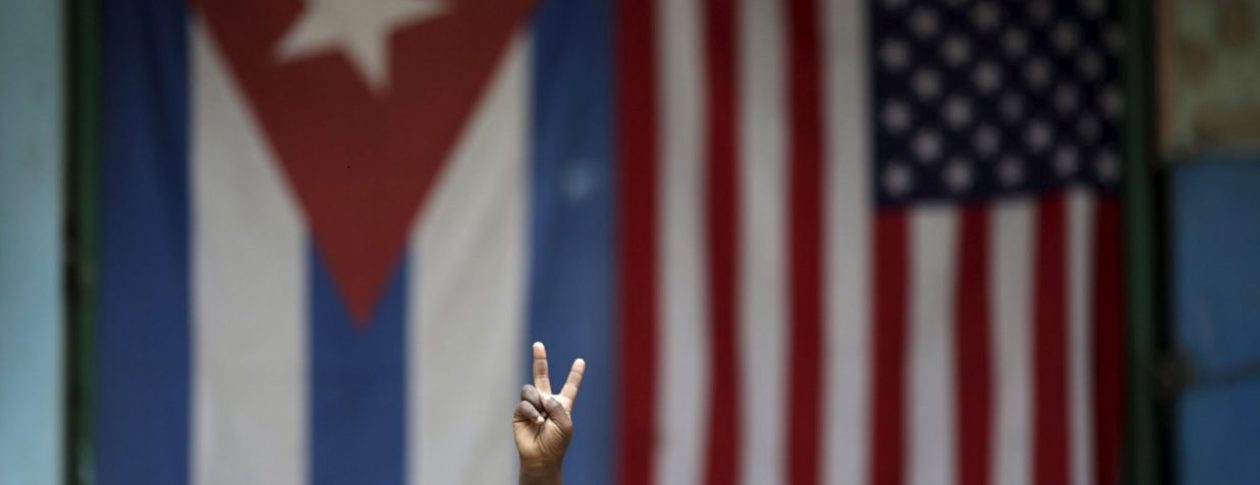
The blockade is an outdated policy and must end: Josefina Vidal, director general for the United States at the Cuban Ministry of Foreign Relations

CUBA-U.S.

The blockade is an outdated policy and must end
A year after diplomatic relations between the two countries were reestablished on July 20, 2015, Granma International spoke with Josefina Vidal, director general for the United States at the Cuban Ministry of Foreign Relations, to discuss Cuba-U.S. relations as they stand today

Author: Sergio Alejandro Gómez | informacion@granma.cu
july 20, 2016 14:07:30

f0013079


Josefina Vidal, director general for the United States at the Cuban Ministry of Foreign Relations. Photo: Juvenal Balán

“We have been working for many years for a change in U.S. policy toward Cuba,” stated Josefina Vidal, the main face representing Cuba in diplomatic negotiations with the United States to open a new chapter in bilateral relations between the two nations.

But the Cuban diplomat isn’t referring to the quarter of a century she has spent dealing with this issue. “You need to read history and see how Fidel, at different times, expressed Cuba’s willingness to discuss and resolve our differences with the United States through negotiations, without renouncing a single one of our principles. And Army General Raúl Castro Ruz, on assuming the leadership of our government, stated that we have always been willing to normalize relations with that country on the basis of equality.

“This process began on December 17, 2014, following more than half a century of resistance by the Cuban people to all kinds of aggression. A few months later, on July 20, 2015, diplomatic relations between the two nations were officially reestablished with the opening of respective embassies in Washington and Havana.”

A year on, Granma International spoke with Josefina Vidal, director general for the United States at the Cuban Ministry of Foreign Relations, to discuss Cuba-U.S. relations as they stand today.

What has been achieved?

Continue reading The blockade is an outdated policy and must end: Josefina Vidal, director general for the United States at the Cuban Ministry of Foreign Relations →

Leading National Latino Coalition Calls for Lifting of Cuban Trade Embargo Washington, D.C.


27167c8e-88f5-48da-ee8a-1ffe7536ecb2


PRESS RELEASE
FOR IMMEDIATE

DISTRIBUTION
July 5, 2016
Leading National Latino Coalition Calls for Lifting of Cuban Trade Embargo
Washington, D.C. – In a major indicator that the U.S.-Cuban relationship is changing dramatically, the National Hispanic Leadership Agenda (NHLA), a coalition of 40 of the nation’s preeminent Latino advocacy organizations, called for lifting of the Cuban Trade Embargo. At its June 22nd board meeting, NHLA adopted the following resolution:
“The National Hispanic Leadership Agenda (NHLA) supports the full normalization of relations between the United States and Cuba. We do not support the Cuban Trade Embargo because we recognize that it does not promote mutually beneficial economic, cultural and scientific relations between both countries. We believe this can be best achieved through an active and open engagement between them. The current policies only serve to impede the full human development of the people of Cuba and Americans, including Cuban-Americans. Support for normalization is, also, strong among Americans, the people of Cuba and a majority of Cuban-Americans.”
“Following the resumption of diplomatic relations between the United States and Cuba, removal of our nation’s trade embargo on Cuba is the next logical step, which will provide a path toward greater engagement between our two nations, to the benefit both nation’s peoples and particularly for the much-needed advancement of human rights and economic well-being for the Cuban people,” said Hector Sanchez, NHLA Chair and Executive Director of the Labor Council for Latin American Advancement.
“This is a historic moment for the Latino community,” stated Angelo Falcón, Co-Chair of NHLA’s Cuban Trade Embargo Working Group and President of the National Institute for Latino Policy (NiLP), “The leading mainstream Latino civil rights organizations have historically avoided addressing the issue of U.S.-Cuban relations in deference to the anti-Castro Miami exile community, but this support for the lifting of the embargo marks a major departure from longtime political accommodation.” Falcón went on to point out that “this development reflects a change not only in the Latino community in general, but also within the Cuban-American community, which is undergoing significant generational changes in their politics.”

Continue reading Leading National Latino Coalition Calls for Lifting of Cuban Trade Embargo Washington, D.C. →

Two peoples united by fraternity and solidarity, Puerto Rican mission in Havana

Two peoples united by fraternity and solidarity
On March 8, 1966, a Puerto Rican mission was inaugurated in Havana by the historic leader of the Cuban Revolution, Fidel Castro Ruz, and Puerto Rican independence activist, Juan Mari Bras. The mission works to demand the decolonization of the Caribbean nation, as well as an end to the U.S. blockade of Cuba
Author: Nuria Barbosa León | internet@granma.cu
july 7, 2016 09:07:0

f0012849


During the ceremony at ICAP, the Puerto Rican independence movement repeated their demand for the release of political prisoner, Oscar López Rivera, unjustly incarcerated for over 35 years for his support of Puerto Rican independence. Photo: ICAP

A strong history of fraternity and solidarity unites Cuba and Puerto Rico, demonstrated by the presence in Havana for over 50 years, of a mission from the sister nation, sole representative of Puerto Rico’s independence movement on the island.
Inaugurated March 8, 1966 by the historic leader of the Cuban Revolution Fidel Castro Ruz and Puerto Rican independence activist Juan Mari Bras, the mission works to demand the decolonization of the Caribbean nation, subjected to five centuries of foreign domination, the last 118 by the United States.
The organization also directs its efforts to condemning the criminal economic, commercial and financial blockade imposed by the U.S. government on Cuba, and facilitating cultural exchanges between both peoples.
As such, it has contributed to enabling Puerto Rican students to study in Cuba, like Alberto Rodríguez Rivera, who has just completed his fifth year of Medicine at the University of Medical Sciences in the central province of Las Villas. The young Puerto Rican is grateful for the knowledge he has gained, not only in regards to his profession but also life.

Continue reading Two peoples united by fraternity and solidarity, Puerto Rican mission in Havana →