All posts by JaimeM

Being like Che, today and tomorrow

Being like Che, today and tomorrow
On the 52nd anniversary of Ernesto Guevara’s death, we recall the question posed by Fidel: “What do we want our children to be?” And the answer: “…Like Che”
Author: Dilbert Reyes Rodríguez | informacion@granma.cu
october 8, 2019 10:10:56

f0025707


“I am” or “I will be” is perhaps the most recurrent personal dilemma, in terms of revolutionary ethics, that Che’s memory provokes.
This challenging question weighs heavy in the hearts of conscious individuals, well aware of the living force of Ernesto Guevara’s impeccable example.
It is clear, first of all, that this is not a question for everyone, since he does not mean the same thing for everyone. A man becomes a symbol only for those who share his dreams, while for others he is simply an historical figure, albeit a renowned one.
Che speaks to us in many ways, as a legend, a leader, soldier, companion, father, a natural man.
Nothing in his life or work needs an explication to defend its value. He did not need it when he was alive, when his posture and acts spoke for themselves, even as a developing young man. Much less later, after his ascension from the world of the living, to that of those who live forever.
From Rosario’s boy to Bolivia’s guerrilla leader, he constantly took on colossal challenges. He responded to his asthma by climbing mountains. To heal the sick? He swam across a jungle river. To understand the pain of his people? He rode a motorcycle across the feverish continent. To help remedy this pain? He gave himself in battle, embarked on an overloaded yacht, fought, and succeeded, making the Revolution that would begin the continental rebellion, in which he already knew he would die.
His unreachable, impossible goals were as legendary as the man, but nonetheless, for mortal revolutionaries who understand him, he left an ample legacy of challenges for daily practice, a framework for the human and the virtuous.
Fidel posed the question: “What do we want our children to be?” – those who we are now, and our own. “We want them to be like Che.”
This is the issue today: Asking ourselves if we are or will be like him, is to understand that the question is not to choose today or tomorrow, but to always be frank, bold, industrious, supportive, critical, decisive, and of course, sensitive dreamers committed to the common good, because seeking individual happiness in itself is not genuine. It is only true when, like the world’s eternal guerrilla, it has a collective soul and a vocation for humanity.

New Treasury Department regulations to tighten the blockade

Six decades of aggression toward Cuba
New Treasury Department regulations to tighten the blockade are intended to disrupt the daily lives of Cubans, including essential health care

Ronald Suárez Rivasoctober 7, 2019 15:10:59

Life goes on in Cuba, with the conviction that there are peoples who do not surrender, and sacred principles, like human dignity and love for the homeland, that will always be worth fighting for.  

f0025705


Photo: Ricardo López Hevia
On his bed in the intensive care unit of Pepe Portilla Pediatric Hospital, where he has lived the last two years and seven months, King Dennys Santiesteban shows me his collection of toy dinosaurs.

He assures me that the fiercest is the Tyrannosaurus Rex, and that there are really big ones that they only eat grass.

At six, he tells me that he already knows how to read and write, thanks to the dedication of his grandmother and the doctors who care for him day and night, but admits that his greatest wish is to return home.

The disease he suffers requires him to remain attached to a mechanical ventilator, so without one at home, he stays here.

Dr. Liliana María Cueto explains that these are very expensive devices, only manufactured by capitalist corporations.

“If the equipment has any component from the United States, it isn’t sold to our country,” she says.

Liliana points out that, if there is one area which the U.S. blockade impacts every day, it is public health.

“We feel the lack of medications, such as first-generation antibiotics and equipment with some component of U.S. origin. The firms that produce them are afraid to sell to us, or if they do, they don’t supply us with spare parts.”

Nonetheless, Cuban doctors are committed to defending life and fighting disease. After more than half a century of resistance, it has almost become normal for a country in which most of its inhabitants were born under the effects of the blockade.

But nothing more cruel and anachronistic than this genocidal policy, supported by more than a dozen administrations in the White House. Continue reading New Treasury Department regulations to tighten the blockade

Raúl receives highest state distinction granted by China

Raúl receives highest state distinction granted by China to friends in other nations
Chinese President Xi Jinping awards his country’s Friendship Medal to the First Secretary of the Communist Party of Cuba Central Committee, Army General Raúl Castro Ruz
Granmaoctober 1, 2019 09:10:23f0025663


Cuba’s ambassador in Beijing, Miguel Ángel Ramírez, accepted the award on behalf of Raúl. Photo: CubaSI

Chinese President Xi Jinping, on September 29, presented his country’s Friendship Medal awarded to the First Secretary of the Communist Party of Cuba Central Committee, Army General Raúl Castro Ruz.
Miguel Ángel Ramírez, Cuban ambassador to that nation, received the distinction, according to Cubaminrex, in a ceremony held at the Great Hall of the People, where 41 Chinese and international figures were also recognized.
Raul is one of six individuals who were awarded the Friendship Medal, the highest state honor conferred on friends in other nations for their contributions in support of China’s socialist modernization and international cooperation with the country, and promoting world peace.
The granting of this important distinction to the Army General confirms the excellent state of relations between China and Cuba. As Raúl expressed at a meeting of leaders from China and Latin America and the Caribbean, held in Brasilia, on July 17, 2014, “More than half a century of cooperation with this country have allowed us to move forward in the development of a model relationship, which has stood the test of time.”
The medal is part of a recognition system created in 2017 and is the highest honor that the President of China grants to dignitaries and foreign friends for the merits cited above. Russian leader Vladimir Putin was the first to receive the distinction in June of 2018.
Xi Jinping presented the Republic and Friendship medals, plus other honorary titles in the context of the 70th anniversary celebrations of the People’s Republic of China’s founding.

Cuban foreign minister: Warming with US is irreversible

World
Cuban foreign minister: Warming with US is irreversible
Associated Press IAN PHILLIPS and MICHAEL WEISSENSTEIN,Associated Press 1 hour 54 minutes ago

Cuban Foreign Minister Bruno Rodriguez Parrilla talks during an interview with The Associated Press, Tuesday, Oct. 1, 2019 in New York. The foreign minister says he believes improvements in relations with the United States are irreversible despite the Trump administration’s hardening of the embargo on the island.

fb947c1b645700185ec50fc06f12ea15


(AP Photo/Mark Lennihan)
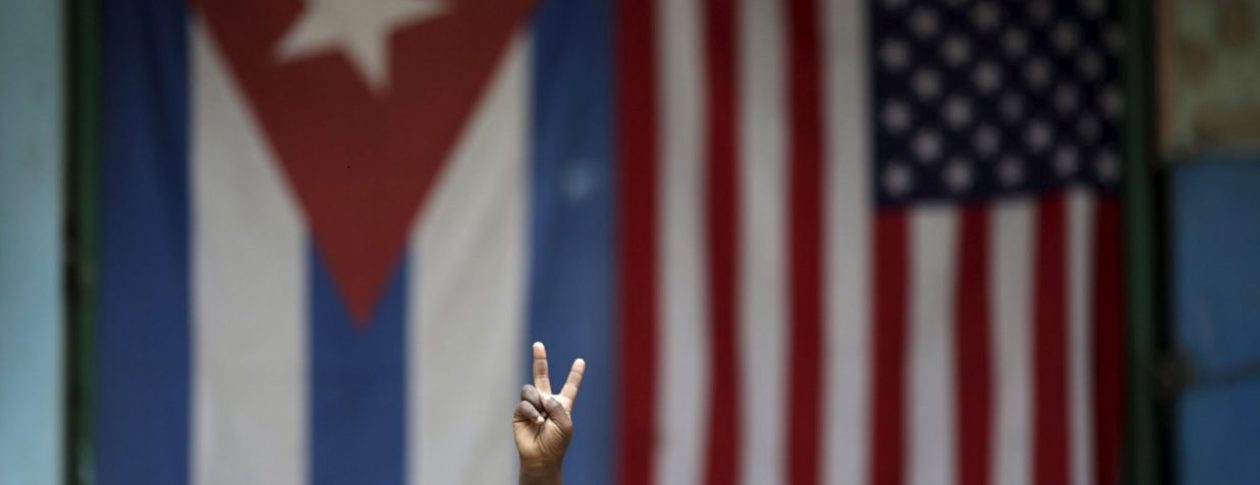
NEW YORK (AP) — Cuba’s foreign minister said Tuesday that he believes improvements in relations with the United States are irreversible despite the Trump administration’s hardening of the embargo on the island.

Foreign Minister Bruno Rodríguez Parrilla told The Associated Press that while the U.S. administration has cut off most communication with Cuba and is trying to pressure the communist government by restricting the flow of oil, progress made under former U.S. President Barack Obama has not been undone.

“I would describe myself as extremely optimistic,” Rodríguez said. “There’s a historical trend that’s irreversible.”

He said relations between the two countries would never return to the way they were before December 2014, when Obama and then-Cuban President Raúl Castro declared that they would reestablish diplomatic relations.

“There have been levels of communication and mutual familiarity between the peoples of both countries that are irreversible,” Rodríguez said.

He said Cuba was prepared for a worsening of tensions during the presidential campaign season because the Trump administration believes that Cuban Americans in South Florida support a hard line on the island.

He called that an “erroneous political calculation.”

“I believe it’s proven that the majority of Cubans in Florida support the advances in the normalization of relations and the lifting of the blockade, and the younger they are, the more they support it,” Rodríguez said. “Regardless, political moments are ephemeral. We have the political will to advance without delay.”

He also says Cuba is finding ways to buy oil despite U.S. attempts to stop it by imposing sanctions on shipping firms and threatening third countries, insurance firms and others with retaliation for helping Cuba obtain petroleum.

Oil shortages led to cutbacks in government fuel consumption and distribution last month, resulting in long lines at gas stations and reductions in public transport.

“We’ve increased our ability to transport (oil). The way the world works today makes it impossible for the United States to impede the arrival of oil tankers in Cuba,” Rodríguez said.

The Trump administration says it is trying to force Cuba to stop supporting Venezuelan President Nicolás Maduro, whom the U.S. says receives military and intelligence help from Cuba.

The Cuban foreign minister flatly denied that his country was providing any military, security or intelligence help to Venezuela, contradicting Trump’s Sept. 24 accusation before the U.N. General Assembly that “Maduro is a Cuban puppet protected by Cuban bodyguards.”

“We don’t have a military presence in Venezuela. We don’t participate or assist military, security or intelligence operations,” Rodríguez said. “The relationship between Cuba and Venezuela is a pretext. … They’re attacking the successful (Cuban) political model, which works, which is a successful economic and social model, because it’s withstood six decades despite the (U.S.) blockade.”