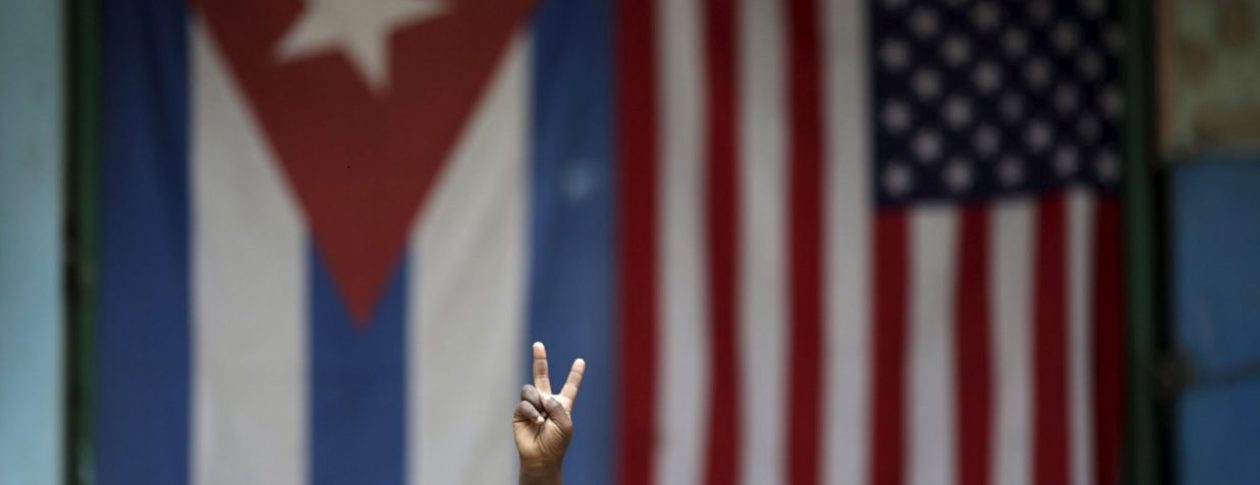
Join us in Welcoming the Cuban Delegation, United Nations 73rd General Assembly
All posts by JaimeM
The United States threatens Latin America and the Caribbean as a Zone of Peace
The current U.S. administration has escalated its intervention in the region during 2018, and recently approved a record “defense” budget of 716 billion dollars for 2019
Author: Yisell Rodríguez Milán | informacion@granmai.cu
august 21, 2018 14:08:55
Photo: wordpress.com
More than 76 military bases in Latin America, support for military and judicial coups against Presidents, the attempted assassination of Nicolás Maduro, sanctions and economic blockades are only some of the strategies being implemented by the United States in Latin America and the Caribbean in its attempt to reverse the victories achieved by progressive governments over the last few decades.
The Second Summit of the Community of Latin American and Caribbean States (CELAC) proclaimed the region a Zone of Peace in January 2014, but the U.S. is set on undermining this consensus.
Secretary of State Rex Tillerson toured the region in February this year and Vice President Mike Pence in June, promoting the U.S. agenda.
Now it is Defense Secretary James Mattis has toured Brazil, Argentina, Chile and Colombia, seeking military and diplomatic allies.
Recent events confirm the escalation:
– The president of Bolivia, Evo Morales, recently denounced a “covert invasion” of Latin America with the deployment of a vessel capable of transporting combat helicopters. The excuse: humanitarian aid to Venezuelans living in Colombia.
– The capabilities of the Southern Command, with its network of military bases and the Fourth Fleet, have been strengthened.
– On the cultural front, big capital moves its media, churches, and technological resources, to demobilize youth, promoting the idea that socialism is not viable and social justice not the state’s responsibility.
– In official statements by the Trump administration, the Monroe Doctrine is proudly presented as more relevant than ever.
– The United States continues to promote non-governmental initiatives, aggressive media campaigns, and cooperation between judicial powers and Washington-controlled organizations, to carry out a targeted, brutal war against the left in the region.
These strategies are in line with “regime change” schemes, which claim millions of victims around the world and promote violence, war, humanitarian crises, and instability, at any cost.
The United States has some 800 military bases around the world
U.S. military presence in Latin America & the Caribbean
The United States has some 800 military bases around the world, with 76 in Latin America and the Caribbean to protect its hegemonic interests in the region
Author: Raúl Capote Fernández | informacion@granmai.cu
august 15, 2018 15:08:05
Photo: Archive
The United States has some 800 military bases around the world, and 76 of these are in Latin America. Among the best known are 12 in Panama, 12 in Puerto Rico, nine in Colombia, and eight in Peru, with the greatest number concentrated in Central America and the Caribbean.
In March of 2018, the U.S. Southern Command released information on its strategy for our region over the next ten years, the principle dangers and threats identified, and plans to confront these. Mentioned in this context were Cuba, Venezuela, and Bolivia; the struggle against drug trafficking; regional and transnational criminal networks; the greater presence of China, Russia, and Iran in Latin America and the Caribbean; disaster response (remember the “aid” given Haiti after the earthquake); as well as the role assigned to security forces in every country in terms of internal, regional, and international order. (1)
Continue reading The United States has some 800 military bases around the world
With all and for the good of all
The press at a decisive civic moment
The press will play a decisive role in the constitutional reform consultation which began August 13 across the country, the most decisive civic test of recent years, according to sector leaders`
Author: Alejandra García | internet@granma.cu
august 16, 2018 10:08:07
With all and for the good of all.
Photo: Osval
The press and journalists will play a decisive role in the constitutional reform consultation which began August 13 across the country, the most decisive civic test of recent years, according to experts and professionals who spoke during a conference yesterday, August 15.
The challenge we face of building consensus, around changes to be made in the Constitution, begins with considering the opinions of others for the good of all, commented Ricardo Ronquillo Bello, president of the Union of Cuban Journalists (UPEC), during a panel discussion entitled “The press in Cuba at the crossroads of a new Constitution.”
Ronquillo, who participated digitally, insisted that this process demands innovation and creativity of journalists, on traditional platforms and on channels offered by new information technology, so the debate is transparent and the way opinions are collected and evaluated is clear to all.
Dr. Rosa Miriam Elizalde, UPEC first vice president, emphasized the importance of knowing the country’s constitutional history, beginning in the
Guáimaro Constitution of 1869, which included freedom of the press among Cubans’ individual rights.
She noted however that past guarantees have referred only to the rights reporters and media, and not of those seeking information. The current proposal, she pointed out, establishes freedom of expression and access to information, as well as the responsibility of all authorities to make public information they have.
Dr. Elizalde emphasized as well, “This document safeguards the political, class character of our press, defining the property that sustains it as socialist, owned by the people as a whole, blocking the possibility that a private monopoly remerge in Cuba’s media sector.”
The meeting took place at UPEC headquarters in Havana, with journalists, experts, and academics participating, and served to recall the organization’s former president Antonio Moltó, who died August 15, 2017, as well as other journalists recently deceased: Ana María Radaelli, Jesús Hernández, Pedro Hernández Soto, Lázaro Fernández, Rafael Daniel, and Renato Recio, among others.
UPEC has activated an email account to receive comments on issues related to the press included in the proposed Constitution: constitucion@upec.cu.


You must be logged in to post a comment.