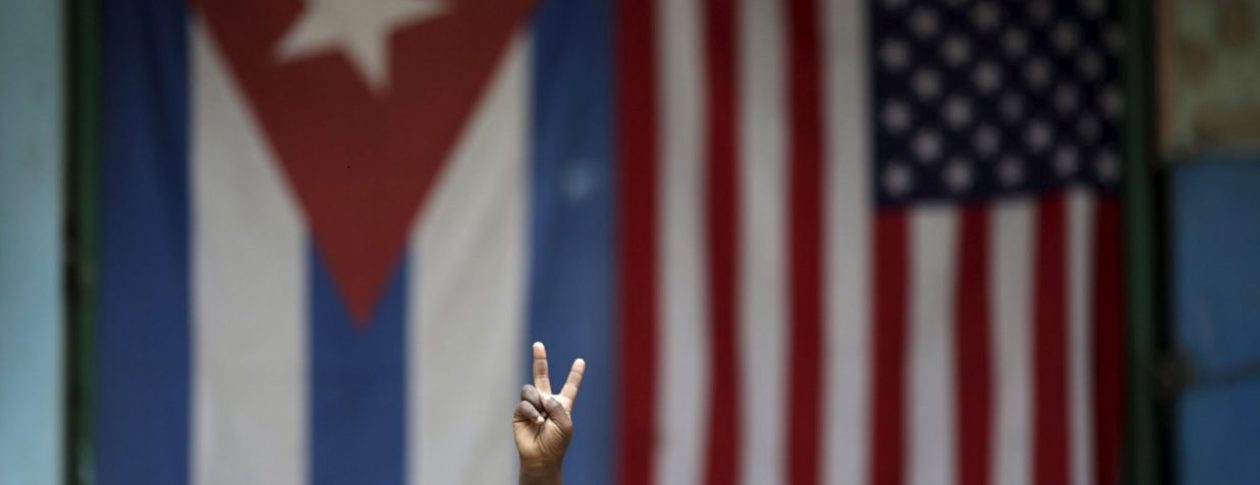
Economic sanctions: a “non-violent measure” that takes lives

Although the declared objective is to force behavioral changes, economic sanctions especially harm Photo: Granma

Economic sanctions imposed unilaterally by some States do kill. This was recalled by a publication of Misión Verdad, based on a study by the journal The Lancet Global Health.
The analysis – led by economists Francisco Rodríguez, Silvio Rendón and Mark Weisbrot, and supported by data from 152 countries – states that these restrictive measures “imposed by the United States or the European Union were associated with 564,258 deaths per year between 1971 and 2021”.
Although the stated objective is to force behavioral changes, according to the researchers, “all economic sanctions ultimately function as health sanctions,” affecting access to medical services, food security and socioeconomic development, which especially harms “children, women and the most marginalized populations.”
Another article published in the journal reveals that, as a result of sanctions, there has been a “3.1% increase in infant mortality and a 6.4% rise annually in maternal mortality between 1990 and 2019.”
It argues that the increase in sanctions has been steady since 1950, according to the Global Sanctions Database. However, “their success rate in achieving the stated goal remains at around 30%”.
Mission Truth exposes that “Venezuela, subject to sanctions as of 2017, recorded between 2012 and 2020 an economic contraction of 71 %, and shortage peaks that directly affected the availability of oncological treatments and retrovirals. In Iraq, the embargo imposed after the invasion of Kuwait coincided with the death of more than 500 000 children during the 1990s, according to Unicef,” he underlines.
“Syria accumulated successive rounds of sanctions since 2011, reinforced with the Caesar Law, in 2020, and today has 90% of its population below the poverty line.”
In the case of Cuba, according to the latest report presented to the United Nations, just four months of blockade “is equivalent to the financing required to cover the needs of the country’s basic list of medicines for a year”.
“For countries under sanctions, induced shortages are not a surgical intervention but a sustained form of coercion. With an additional 564 000 deaths per year, the label of ‘non-violent measure’ collapses,” the publication reads.

To the martyrs of the Revolution, the homage of Santiago and all Cuba

In its streets, Santiago de Cuba raised Frank País. Photo: Luis Alberto Portuondo

Santiago de Cuba. -The people of Santiago, in pilgrimages to the intersection of Callejón del Muro and San Germán, and the Santa Ifigenia patrimonial cemetery, paid homage to their beloved son Frank País García and his companion in struggle, Raúl Pujol Arencibia, who were assassinated by henchmen of the Batista tyranny on July 30, 1957, date consecrated as the Day of the Martyrs of the Revolution.
At the Martyrs’ Altarpiece in Santa Ifigenia, floral offerings were placed by the leader of the Cuban Revolution, Army General Raúl Castro Ruz; the First Secretary of the Central Committee of the Party and President of the Republic, Miguel Díaz-Canel Bermúdez; Esteban Lazo Hernández, president of the National Assembly of People’s Power and the Council of State, and the Cuban people.
Díaz-Canel expressed in X that in both patriots “we have references of virtue, and also the pride of knowing that we come from Cubans like them”.
To the rhythm of patriotic marches, played by the Municipal Concert Band, the highest political and governmental authorities of Santiago and the people arrived at the Martyrs’ Square, where a wreath was placed on behalf of the people of Cuba, at the base of the monument that commemorates the event of which Fidel said: “What monsters! They do not know the intelligence, the character, the integrity that they have murdered”.
During the day of tribute, Party militant cards were given to outstanding workers, and in the afternoon, the funeral honors that the people of the Hero City held that day were reedited in honor of Frank, of whom Army General Raúl Castro Ruz said: “he was upright in principles, organized and demanding, of a proverbial modesty, courageous to the point of recklessness and of uncommon intuition; he was the kind of man who penetrates deeply and definitively into the heart of the people”.

Photo: Taken from X 

The fraternal meeting in Geneva between Esteban Lazo Hernández, member of the Political Bureau, Cand the Council of State, and Valentina Matvienko, president of the Federation Council of the Federal Assembly of the Russian Federation, in the context of the Sixth World Conference of Speakers of Parliament, was a demonstration of the close and strategic relations between Cuba and Russia.

Lazo conveyed greetings from Army General Raúl Castro Ruz, leader of the Cuban Revolution, and Miguel Díaz-Canel Bermúdez, First Secretary of the Central Committee of the Party and President of the Republic.

Matvienko highlighted the close ties between the two legislative bodies, as well as the significance of Cuba’s incorporation into BRICS as a partner country and into the Eurasian Economic Union as an observer state.

Lazo also spoke with the president of the National Assembly of Cambodia, Khuon Sudary; the president of the Chamber of Deputies of Equatorial Guinea, Salomón Nguema Owono; and the president and secretary general of the Inter-Parliamentary Union, Tulia Ackson and Martin Chungong, respectively, whom he thanked for their firm rejection of the US economic blockade against Cuba.

He exchanged views with Zhao Leji, member of the Standing Committee of the Political Bureau of the Central Committee of the Communist Party of China and chairman of the Standing Committee of the National People’s Congress; and with Rawhi Fattouh, head of the Palestinian National Council, and participated in the opening of the World Conference of Speakers of Parliament.

He also participated in the parallel event Respecting International Law and the United Nations Charter to Ensure International Peace and Security, in which he reaffirmed his condemnation of Israel’s attacks on Iran and reiterated Cuba’s support and solidarity with the cause of the Palestinian people.

Beats of 26 all over Cuba

Photo: Pastor Batista

Yesterday, hundreds of inhabitants of the municipality of Diez de Octubre celebrated, on behalf of all Havana residents, the political-cultural act in salute to the 72nd anniversary of the assault on the Moncada and Carlos Manuel de Céspedes barracks, an exceptional moment that the people of Espiritu also experienced, with the added motivation of having been an outstanding province.
The members of the Political Bureau of the Central Committee of the Party, Manuel Marrero Cruz, Prime Minister of the Republic, and Bruno Rodríguez Parrilla, Minister of Foreign Affairs, presided over the central activities in the capital municipality; while the member of the Secretariat of the Central Committee and head of its Department of Services, Yudí Mercedes Rodríguez Hernández, accompanied the day in Sancti Spíritus.
As usual in these spaces, recognition was given to personalities, organizations and institutions whose contribution has been decisive for the main advances and results in the economic, political and social fields.
Once again, the majority support of the people to their Revolution was evidenced.