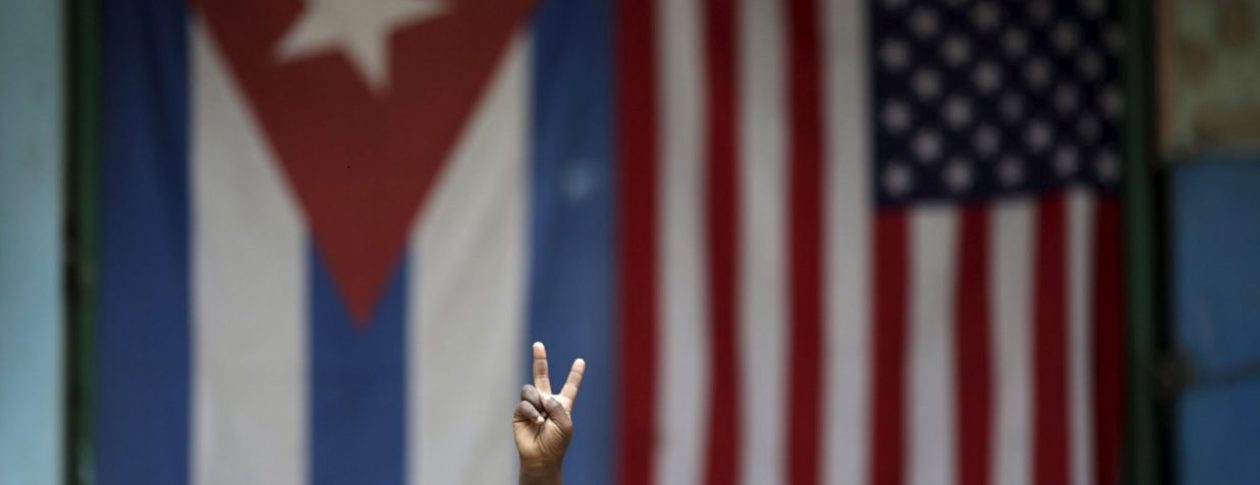
U.S. imperialism adds fuel to the fire

U.S. imperialism adds fuel to the fire, but from afar
Economic, commercial and financial sanctions, as a means to exert pressure on a country, do not solve the current crisis, but rather add fuel to the fire and aggravate the international economic situation

Author: Madeleine Sautié Rodríguez | informacion@granmai.cu
march 16, 2022 11:03:58


Photo: Artwork by Pawel Kuczynski
Miguel Díaz-Canel Bermúdez Communist Party of Cuba Central Committee First Secretary and President of the Republic cited three elements that are sustaining and aggravating the world’s current difficulties, during his closing remarks at the Ministry of Culture’s annual review for the year 2021, held at José Martí National Library.
The tightened United States’ economic, commercial and financial blockade of Cuba; the aggressiveness of the United States internationally; and the uncertainty created by covid-19 were the three issues impacting the current situation he emphasized.
With regard to the blockade, the President said that we are now experiencing a different moment, a particular feature of recent years, “Things began to get very complicated in the second half of 2019, when the Trump administration adopted more than 240 measures that cut off our sources of financing. They placed us on their list of countries that allegedly support terrorism. And all this has been maintained under Joe Biden’s administration,” he explained.
The blockade, he recalled, has caused shortages, financial persecution, persecution of fuel suppliers, in particular, and to this was added the even greater aggressiveness of the U.S. government against Cuba, with a broad media campaign demonizing our country, in an attempt to discredit all elements of the Cuban Revolution, seeking to construct the appearance of total failure, that everything is wrong and everything the country does to mitigate current conditions does nothing to solve the problems, he stated.
The President pointed out that this aggressiveness can be seen in the way the events of July 11 were addressed and the way a play was staged, announcing to the world that on November 15 the Cuban Revolution would collapse, and now they are attempting to distort Cuba’s position with respect to the current events in Europe. This imperialist hostility is not only directed toward Cuba; it is evident at a global level, he noted. Continue reading U.S. imperialism adds fuel to the fire

Cuba closes Saturday with 482 new Covid-19 infections and one deceased

06 March 2022
Translated by Walter Lippmann for CubaNews.

At the close of yesterday, March 5, 7,238 patients were hospitalized, 4,830 suspected, 43 under surveillance, and 2,365 confirmed active.

For COVID-19, a total of 11,239 samples were taken for surveillance on the day, with 482 being positive for 4.3% positivity. The country accumulates 13 million 155 thousand 339 samples carried out and 1 million 072 thousand 956 positives.

Of the total cases (482): 474 were contacts of confirmed cases, 2 with a source of infection abroad and 6 without a specified source of infection. Of the 482 diagnosed cases, 294 were female and 188 male.

5.6% (27) of the 482 positive cases were asymptomatic, accumulating a total of 145,264, which represents 13.5% of those confirmed to date.

Of the 482 diagnosed cases, they belong to the age groups: under 20 years old (112), 20 to 39 years old (142), 40 to 59 years old (126), 60 and over (102).

La Constitución cubana refuerza la responsabilidad en la administración de justicia

PROCESOS PENALES DEL 11 Y 12 DE JULIO


Impartir justicia es mucho más que dictar sentencia
La Constitución cubana refuerza la responsabilidad en la administración de justicia y, recientemente, todo ello ha sido fortalecido con la reforma procesal, que entró en vigor en enero del presente año

Autor: Yaditza del Sol González | internet@granma.cu
13 de febrero de 2022 18:02:35


Entre las garantías que establece la Carta Magna cubana para el debido proceso penal en su artículo 95 está la presunción de inocencia hasta la sentencia firme en contra. foto Tomada de la web del Tribunal Provincial de la Habana Foto: Cortesía del Tribunal Supremo Popular

Iginio sube al estrado. Va vestido con su uniforme azul de policía, es joven y de constitución menuda, pudiéramos decir, pero cuando habla, lo hace con seguridad, sin titubear.

Es el segundo día del juicio oral contra 33 acusados que participaron en los disturbios que ocurrieron el 11 de julio pasado en las inmediaciones de Toyo, en la capital, y tanto la Fiscalía como la defensa han tenido la posibilidad de presentar los testigos que consideran necesarios para el desarrollo del caso.

–¿Estuvo usted en los sucesos ocurridos en la esquina de Toyo?

–Sí, eran como las cuatro o cinco de la tarde más o menos.

–¿En qué llegó usted a ese lugar?

–En el carro patrulla… me acompañaba mi chofer, Yodianys Viera Ávila.

–¿Recuerda dónde dejó estacionado el vehículo?

–En la misma esquina de Toyo y 10 de Octubre.

–¿Hacia dónde se dirigió después que dejó parqueado el vehículo?

–Hacia adelante, porque al otro carro que estaba ahí, un Hyundai, lo estaban golpeando y tirándole piedras, y nosotros fuimos a apoyar.

–¿Había oficiales a su alrededor?

–No. Los dos oficiales estaban dentro de ese carro…, por eso me acerqué, tratando de que las personas que estaban ahí se alejaran, y así ellos pudieran salir del carro y venir con nosotros.

–¿Mientras usted realizaba esta acción, resultó golpeado por algunas de esas piedras?

–Sí. Una me dio en el estómago y otra en el tobillo.

Después de auxiliar a sus compañeros, Iginio no pudo volver a montarse en la patrulla 162. «Un cielo nublado de piedras», según sus propias palabras, comenzó a caer sobre ellos. En ese momento, asegura, sintió miedo.

Mientras lograba salir del lugar, vio de reojo cómo estas personas abrieron las puertas del carro patrulla, y empezaron a sacar las cosas que estaban dentro; «y ahí, entre como cinco, lo cogieron por un costado y lo viraron», relata.

Entre las pertenencias que robaron, estaba la planta y el parlante del

vehículo, el celular de su chofer y 8 000 pesos que él guardaba de su salario para comprarse un teléfono.

Su nombre es Iginio Castellano Cala, tiene apenas 20 años y es jefe de carro de la Policía Nacional Revolucionaria.

***
Continue reading La Constitución cubana refuerza la responsabilidad en la administración de justicia