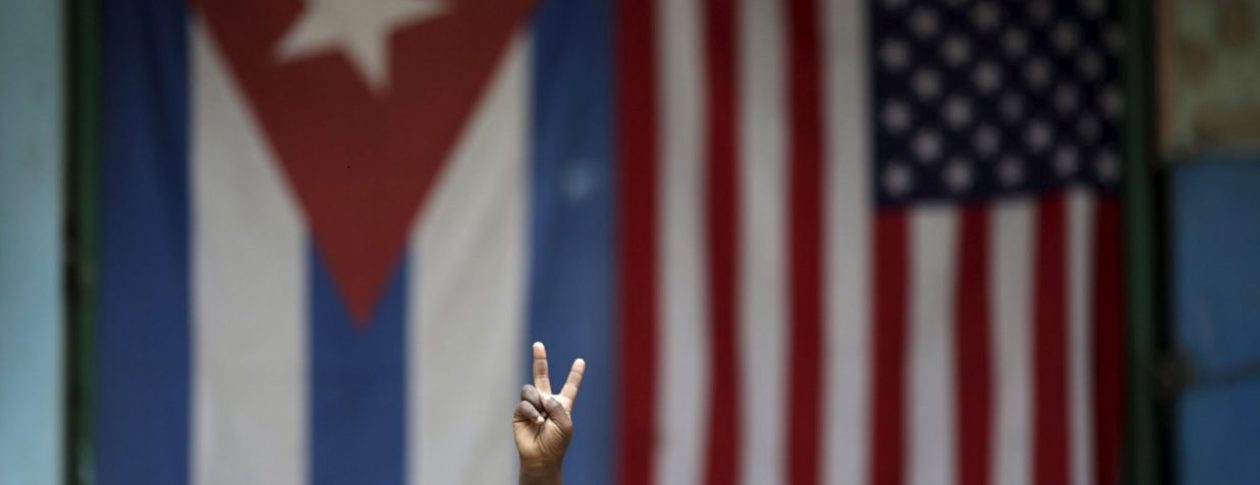
The United States has some 800 military bases around the world

U.S. military presence in Latin America & the Caribbean
The United States has some 800 military bases around the world, with 76 in Latin America and the Caribbean to protect its hegemonic interests in the region

Author: Raúl Capote Fernández | informacion@granmai.cu
august 15, 2018 15:08:05

f0022949


Photo: Archive

The United States has some 800 military bases around the world, and 76 of these are in Latin America. Among the best known are 12 in Panama, 12 in Puerto Rico, nine in Colombia, and eight in Peru, with the greatest number concentrated in Central America and the Caribbean.

In March of 2018, the U.S. Southern Command released information on its strategy for our region over the next ten years, the principle dangers and threats identified, and plans to confront these. Mentioned in this context were Cuba, Venezuela, and Bolivia; the struggle against drug trafficking; regional and transnational criminal networks; the greater presence of China, Russia, and Iran in Latin America and the Caribbean; disaster response (remember the “aid” given Haiti after the earthquake); as well as the role assigned to security forces in every country in terms of internal, regional, and international order. (1)

Continue reading The United States has some 800 military bases around the world

With all and for the good of all

The press at a decisive civic moment
The press will play a decisive role in the constitutional reform consultation which began August 13 across the country, the most decisive civic test of recent years, according to sector leaders`

Author: Alejandra García | internet@granma.cu
august 16, 2018 10:08:07

With all and for the good of all.

f0022951


Photo: Osval
The press and journalists will play a decisive role in the constitutional reform consultation which began August 13 across the country, the most decisive civic test of recent years, according to experts and professionals who spoke during a conference yesterday, August 15.
The challenge we face of building consensus, around changes to be made in the Constitution, begins with considering the opinions of others for the good of all, commented Ricardo Ronquillo Bello, president of the Union of Cuban Journalists (UPEC), during a panel discussion entitled “The press in Cuba at the crossroads of a new Constitution.”
Ronquillo, who participated digitally, insisted that this process demands innovation and creativity of journalists, on traditional platforms and on channels offered by new information technology, so the debate is transparent and the way opinions are collected and evaluated is clear to all.
Dr. Rosa Miriam Elizalde, UPEC first vice president, emphasized the importance of knowing the country’s constitutional history, beginning in the
Guáimaro Constitution of 1869, which included freedom of the press among Cubans’ individual rights.
She noted however that past guarantees have referred only to the rights reporters and media, and not of those seeking information. The current proposal, she pointed out, establishes freedom of expression and access to information, as well as the responsibility of all authorities to make public information they have.
Dr. Elizalde emphasized as well, “This document safeguards the political, class character of our press, defining the property that sustains it as socialist, owned by the people as a whole, blocking the possibility that a private monopoly remerge in Cuba’s media sector.”
The meeting took place at UPEC headquarters in Havana, with journalists, experts, and academics participating, and served to recall the organization’s former president Antonio Moltó, who died August 15, 2017, as well as other journalists recently deceased: Ana María Radaelli, Jesús Hernández, Pedro Hernández Soto, Lázaro Fernández, Rafael Daniel, and Renato Recio, among others.
UPEC has activated an email account to receive comments on issues related to the press included in the proposed Constitution: constitucion@upec.cu.

A reflection on the occasion of Fidel’s birthday

Fidel’s Cuba takes on the impossible
A reflection on the occasion of Fidel’s birthday – August 13, the 92nd anniversary of his birth – and a life well lived

Author: Yeilén Delgado Calvo | nacionales@granma.cu
august 13, 2018 09:08:26

Fidel delivers a speech circa 1960.

f0022937


Photo: Osvaldo Salas
Life seems short to humans. We are but specks of light in the infinity of history. Death puts an end to material existence and inexorably arrives for all.
Defeating it, despite all the efforts of those have tried for centuries, can only be accomplished two ways: leaving love, sowed with kindness and devotion, or by developing ideas that surpass the personal to become shared property.
Few men and women have been able to do both and reach a sublime form of immortality. They cease to exist to become a people, and as the date of their deaths recedes in time, their presence continues to spread, like a fire.
Just saying their names is enough to feel their closeness, to sustain and encourage us in the joyful times and those of sacrifice. Thus Fidel remains in our hearts, and as always speaks to us of what makes our country great: the unity of our people facing the impossible.
We must believe in humanity despite the dark sides, to make a Revolution, and understand that the struggle does not end with the victory, but rather truly begins at that moment. This vision is what makes Fidel so magnetic: his caliber as a leader and his unquestionable authority had as their foundation great faith in the will of human beings to grow, and the analytical ability to see beyond the evident.
Amidst our current effort to achieve a Constitution that works for us, not only putting the society we are on paper, but also the society we want to be, it is no accident that today’s date marks the beginning of a time period when we are called upon to speak loud and clear, knowing that politics is the people’s business – something else Fidel taught us.
August 13 does not mark the beginning of a life that lasted 90 years, but rather of a spiral that will continue upward as long as there is someone repeating what has become a moral conviction: Comandante en Jefe, at your orders!

Maduro shows his strength, looks death in the face

Maduro shows his strength, looks death in the face
The self proclaimed T-shirt Soldiers group claimed responsibility for the August 4 attack on the Venezuelan President’s life

Author: Misión Verdad | informacion@granmai.cu
august 10, 2018 15:08:40

Venezuela’s President during an event celebrating the 81st anniversary of the Bolivarian National Guard.

mad-696x465-1


Photo: NET

During an event attended by thousands on Bolivar Avenue in the city of Caracas, on the occasion of the 81st anniversary of the Bolivarian National Guard, two drones exploded close to the Presidential stand, as the country’s head of state was finishing his speech to the crowd.

According to police accounts, the nature of the explosive material the drones carried was confirmed when they crashed. “Unofficial” sources told an opposition journalist named Román Camacho that the artifacts contained C4 plastic explosives.

Minutes after the explosions, a group calling itself Soldados de Franelas (T-shirt Soldiers) took credit for the attack. They have been linked to the now-defunct paramilitary CICPC (Scientific, Penal and Criminology Research Corps) led by Óscar Pérez, which at the end of last year carried out several armed attacks on civilian and military institutions in the country, publicly taking credit on social media.

This acknowledgement on their part invalidated the narrative disseminated about a “self-attack” or an “isolated explosion” in a building adjacent to Bolívar Avenue, which some operatives on social media, and international news outlets like the Associated Press, have attempted to present, to distract attention from the perpetuators and shield those responsible.

Continue reading Maduro shows his strength, looks death in the face